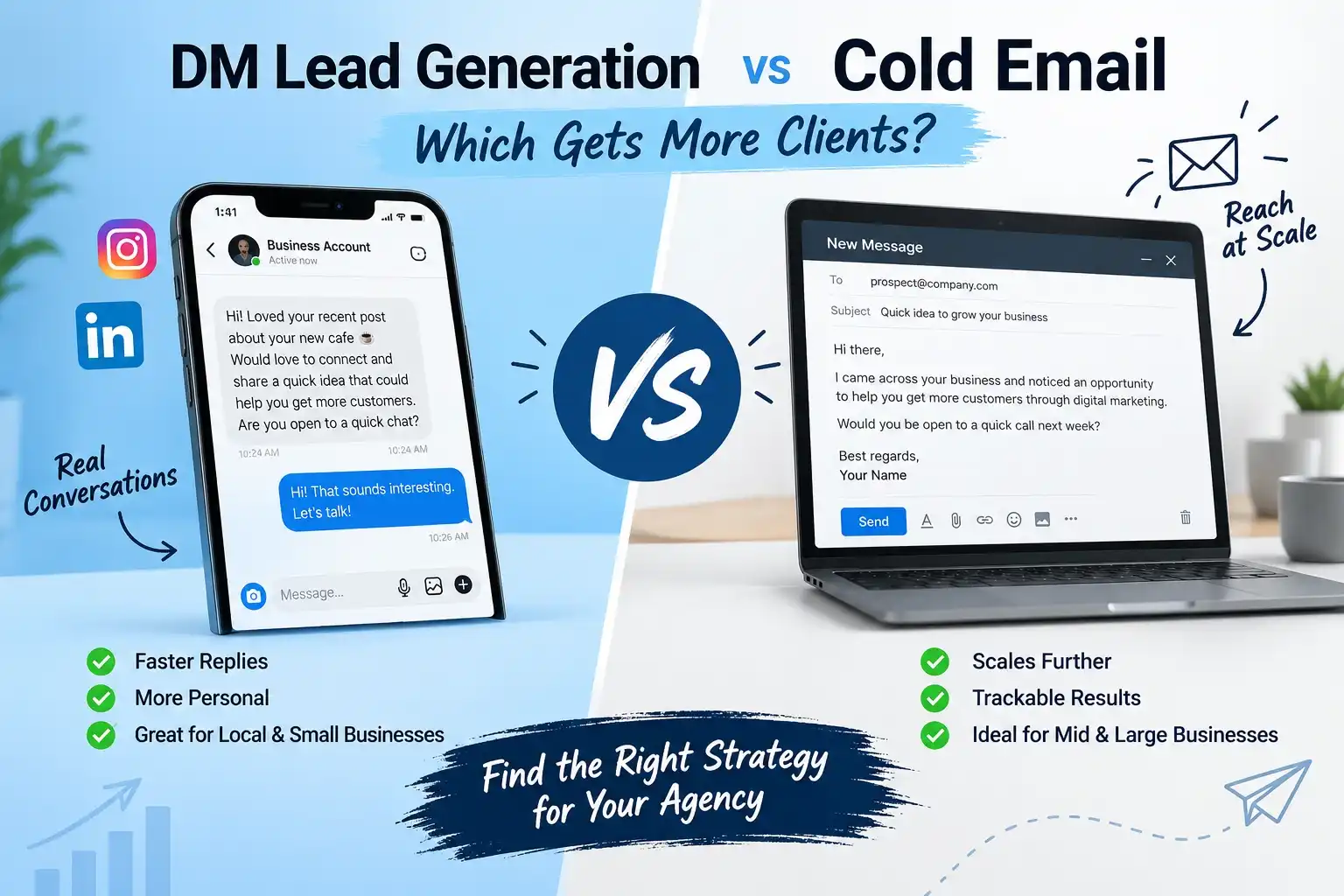
For most agencies, the honest answer is: DM lead generation and cold email win in different situations, and the agencies getting the most clients right now usually run both at the same time instead of picking one. DM outreach tends to get faster replies and feels more personal, but it doesn't scale the same way. Cold email scales further and is easier to track, but it gets ignored more often and needs a real domain and sending setup to work.
If you only have time to run one channel this month, the quick version is this: pick DM outreach (Instagram or LinkedIn) if your ideal clients are individuals or small businesses who are active on social media and you can only send a limited number of messages a day. Pick cold email if you're targeting mid-size or larger businesses, need to reach hundreds of prospects a week, and can invest a few weeks into setting up your sending infrastructure properly.
Why DM Outreach Gets Faster Replies
DM lead generation works because it shows up where people are already paying attention. Someone scrolling Instagram or checking LinkedIn notifications sees a DM the same way they'd see a message from a friend — it lands in a personal space, not a folder full of promotional email.
This changes how people respond. A DM feels like a conversation starting, not a pitch landing. That's why response rate outreach numbers for DMs are usually higher than cold email, especially in the first 24-48 hours after sending. People reply to DMs while they're still in the app; a cold email might sit unread for days.
The tradeoff is volume. A person can genuinely personalize and send maybe 20-40 DMs a day before it starts looking automated or before Instagram/LinkedIn's own limits kick in. Go past that and accounts get flagged, restricted, or shadow-limited — which kills the whole channel, not just that day's batch.
Instagram DM Leads: What Actually Works
Instagram DM leads convert best when the first message references something specific — a recent post, a product launch, a review someone left on the business's page. A generic "Hi, I help businesses grow, interested?" gets ignored or gets a one-word "no thanks." A message that mentions their actual content gets read as a real person, not a bot.
The businesses that respond fastest to Instagram DMs are usually local service businesses, ecommerce brands, and solo entrepreneurs — accounts run by one or two people who check their own DMs. Larger companies with dedicated social media managers are slower to respond because the DM has to go through another person before it reaches a decision-maker.
LinkedIn Outreach: Different Audience, Different Rules
LinkedIn outreach works on a different logic than Instagram. People expect some business messaging on LinkedIn — it's built for professional networking, so a well-written connection request or InMail doesn't feel as out of place as an Instagram DM from a stranger.
The catch is that LinkedIn's algorithm and connection limits are stricter. Sending too many connection requests in a short window triggers restrictions on the account. The better approach is a smaller, targeted list — decision-makers who match a specific role and company size — rather than mass-sending to anyone in a broad industry category.
Why Cold Email Still Works — If It's Set Up Right
Cold email outreach gets a bad reputation because most of it is done badly: no warm-up on the sending domain, generic templates, no segmentation, and no follow-up sequence. When it's set up properly, cold email is still one of the most scalable lead generation channels available, because a single campaign can reach hundreds of prospects a week without the manual, one-by-one effort DM outreach requires.
The setup work matters more than the copywriting. A new domain needs weeks of warm-up (sending small volumes that gradually increase) before it can send cold email at scale without landing in spam. Skip this step and even a great email never gets seen, because it never leaves the spam folder.
Cold email also has a built-in advantage: it's trackable. Open rates, reply rates, and click-through data give a clear picture of what's working and what isn't, campaign by campaign. DM outreach doesn't offer the same level of tracking unless it's run through a dedicated outreach tool.
Is Cold Email Dead in 2026?
No — but the version of cold email that's dead is the spray-and-pray version: buying a list, sending the same template to 10,000 people, and hoping a few reply. Deliverability rules from major email providers have gotten stricter, and generic mass-blasted email gets filtered before a human ever sees it.
What still works is targeted cold email: smaller lists built around a specific problem the recipient actually has, personalized opening lines, and a domain that's been warmed up properly. Agencies running cold email this way are still landing clients through it — the channel isn't dead, the lazy version of it is.
DM Funnel vs Email Sequence: How the Follow-Up Differs
A DM funnel usually moves faster and feels more like a real conversation. First message, a reply, a quick back-and-forth, then a call booked — often within the same day or two. The whole thing can happen in one sitting because both people are already active in the app.
An email sequence is built around patience. A prospect might not open the first email, so a follow-up goes out a few days later, then another a week after that. Most replies to cold email campaigns come from the second, third, or even fourth email in a sequence — not the first one. Agencies who give up after one email are leaving most of their potential replies on the table.
Is DM Lead Generation Better Than Cold Email for Agencies?
It depends on who the agency is trying to reach and how much manual effort is available. For an agency targeting small, social-media-active businesses — local shops, personal brands, ecommerce sellers — DM lead generation usually gets a better response rate outreach per message sent, because the channel matches where those prospects actually pay attention.
For an agency targeting larger businesses, or one that needs volume because DMs alone can't fill the pipeline fast enough, cold email is the better fit. It scales past the daily limits that DM outreach runs into, and once the sequence and segmentation are built, it keeps running with less manual work per lead than DMs require.
The agencies getting the most consistent results usually don't choose one over the other — they run DM outreach for warmer, social-first prospects and cold email for the volume plays, and let each channel do what it's actually good at.
How Many Leads Can DM Outreach Generate Per Month?
This depends entirely on daily sending volume, list quality, and how personalized each message is. An agency sending around 20-30 well-personalized DMs a day, five days a week, is sending roughly 400-600 messages a month. Realistic reply rates for a well-targeted, personalized DM campaign land somewhere in the range of 10-20%, which puts genuine conversations in the range of 40-120 a month — before accounting for how many of those conversations actually turn into booked calls or signed clients.
The number drops fast with generic, unpersonalized messages, and it drops to zero if an account gets flagged for sending too fast. Quality and pacing matter more than raw volume here.
Building a Combined Approach
Running both channels together, rather than treating them as competing choices, tends to produce the strongest results:
Use DM outreach for prospects who are visibly active on social media and match the profile of businesses that respond well to a personal message
Use cold email for prospects who are harder to reach through social platforms, or when the target list is large enough that manual DM outreach isn't realistic
Track both channels separately so it's clear which one is actually producing booked calls, not just replies
Don't abandon a channel after one bad week — cold email needs a full sequence to show its real reply rate, and DM outreach needs a properly warmed-up, un-flagged account to perform