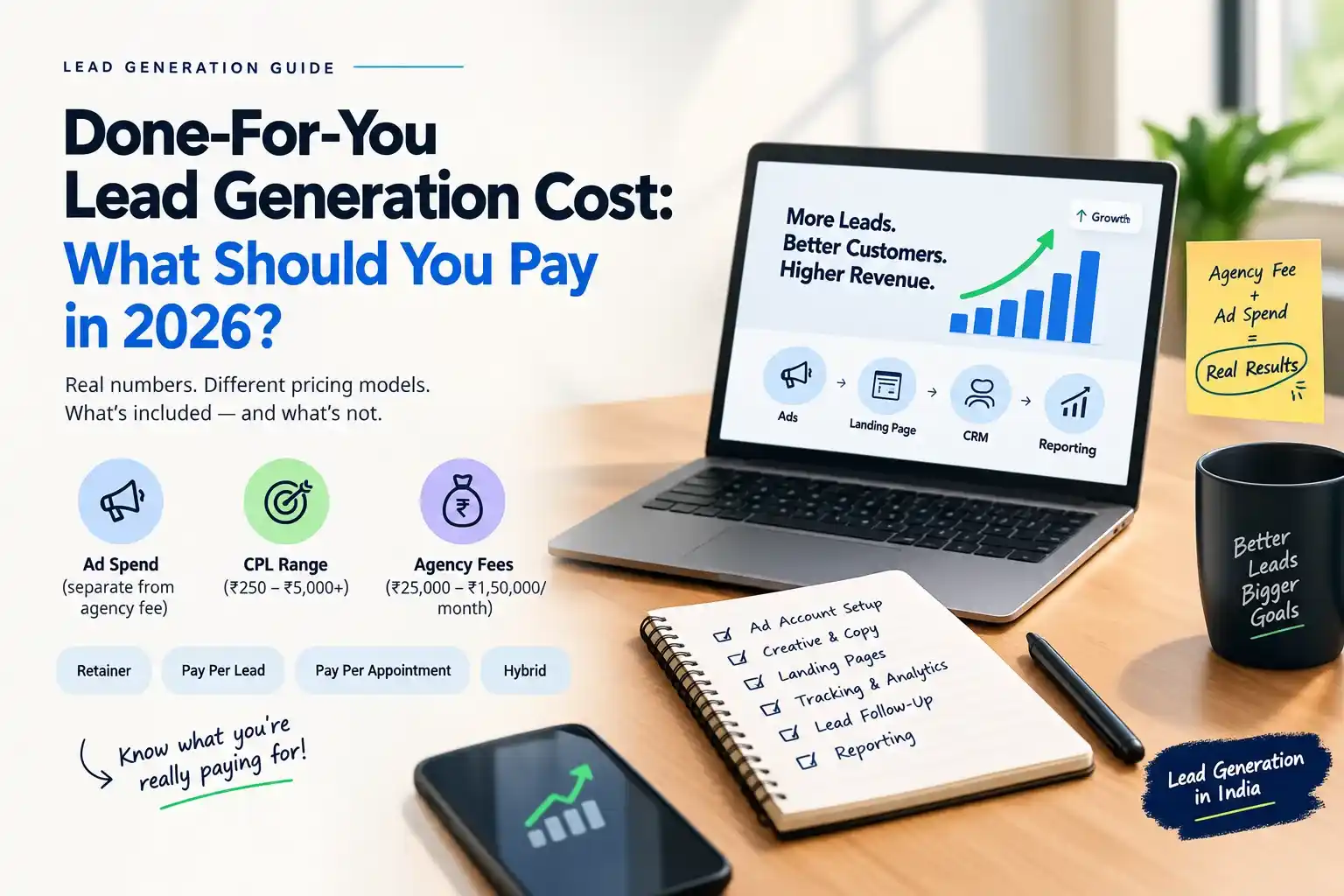
For most Indian small and mid-sized businesses, a managed lead generation programme runs ₹25,000 to ₹1,50,000 per month in agency fees, with ad spend billed separately on top. Pay-per-lead deals in India sit anywhere from ₹250 to ₹5,000 per lead depending on the industry. The wide gap isn't agencies being random about it — it's the difference between someone running your ads and someone owning the whole path from click to closed deal.
Here's how to tell which one you're actually buying.
What "Done-For-You" Is Supposed to Cover
The phrase gets used loosely. Before you compare two quotes, check whether both include the same work:
Offer and messaging — what you're actually promising the prospect, not just "book a demo"
Ad account build — campaign structure, audiences, keyword sets, negative keyword lists
Creative production — ad copy, static creatives, video cuts, and enough variants to test properly
Landing pages — a dedicated page per campaign, not your homepage with a form bolted on
Tracking — GA4, conversion events, call tracking, and a CRM that records where every lead came from
Lead routing and follow-up — WhatsApp flows, auto-responders, lead scoring
Reporting — cost per lead, cost per qualified lead, and what closed
An agency quoting ₹15,000 a month is almost certainly doing items 2 and 3 only. That isn't dishonest, but it isn't done-for-you either. Ask which of the seven they own.
The Line Item People Keep Forgetting
Your management fee and your ad budget are two separate numbers. A ₹40,000 retainer with ₹20,000 of media behind it will underperform a ₹40,000 retainer with ₹1,00,000 of media, and the agency will get blamed for it.
Nico Digital's India CPC benchmarks put the realistic floor for a competitive service category at ₹50,000 to ₹1,50,000 per month in working media — that's the spend needed for the platform to gather enough conversion data to optimise at all. Below that, you're paying for guesswork.
The Four Pricing Models, and Where Each One Breaks
Model | Typical India Range | Works Well When | Breaks When |
|---|---|---|---|
Monthly retainer | ₹25,000–₹1,50,000/mo (enterprise engagements run to ₹10L+) | You want predictable cost and a partner who'll fix the funnel, not just the ads | You have no way to judge output, so you pay the same in a bad month |
Pay per lead | ₹250–₹5,000 per lead by industry | Your "lead" definition is airtight and you have sales capacity to burn | Quality quietly drops — volume is the only thing the agency is paid on |
Pay per appointment | Higher per unit than per-lead; negotiated | You care about meetings held, not form fills | No-shows aren't defined in the contract |
Hybrid base + performance | Base fee plus a percentage or per-outcome bonus | Both sides want skin in the game | The bonus trigger is vague ("qualified lead") |
Global benchmarks show the same shape at a bigger scale — SalesHive puts managed B2B programmes at roughly $2,500 to $15,000 per month, with pay-per-lead deals in the $200–$500 range. Indian pricing is far lower in absolute terms, but the structural trade-offs are identical.
On Monthly Retainer Lead Generation
A retainer buys iteration. Month one is setup and data collection, month two is where targeting starts to sharpen, month three is usually when cost per lead settles. If you sign a retainer and judge it in 30 days, you've paid for the expensive part and quit before the return.
On Pay Per Lead Pricing
This looks like the safe option because you only pay for output. The catch is that the agency optimises for whatever you're paying on. Define the lead — decision-maker, budget confirmed, correct city, correct product — in writing, or you'll receive 200 contacts and close four.
What a Fair Price Per Lead Looks Like in India
There's no single number. CPL is a function of your industry's competition and your customer's value, and India's ranges are nothing like the US figures you'll see quoted in most articles.
Industry (India) | Typical CPL Range | Notes |
|---|---|---|
D2C / retail ecommerce | ₹50–₹200 | Lowest CPCs; volume game |
Ed-tech (Meta) | ₹150–₹800 | Admission cycles swing this hard |
Healthcare / clinics | ₹200–₹800 | Local intent, lower competition than finance |
B2B SaaS | ₹500–₹2,000 (MQL) | Qualified leads cost several times this |
Real estate | ₹800–₹5,000 | Most expensive vertical in India |
BFSI / lending / insurance | ₹2,000–₹7,000 | Highest CPCs, but LTV justifies it |
These ranges are compiled from India-specific benchmark data published by OwlClaw Technologies, Vatican Media, and BrandBear Marketing in 2026. Treat them as a sanity check, not a target.
The number that actually matters is your own. Run this:
Your ceiling CPL = (average deal value × close rate) × 0.20
If you sell a ₹60,000 service and close 10% of leads, each lead is worth ₹6,000 in revenue. Paying ₹1,200 per lead means you're spending 20% of revenue on acquisition — workable for most service businesses. Paying ₹3,000 means you're burning half your margin before you've delivered anything.
This is why "is ₹800 per lead expensive?" is an unanswerable question without your close rate. BrandBear's India data makes the same point sharply: a SaaS business with an annual contract value above ₹2.5 lakh can sustain a CPL of ₹7,000–₹9,000 comfortably, while the same CPL destroys a business selling at ₹60,000 a year.
Realistic Budgets by Business Stage
Stage | Media Spend / Month | Agency Fee / Month | What This Realistically Buys |
|---|---|---|---|
Testing the channel | ₹30,000–₹50,000 | ₹20,000–₹35,000 | One platform, 2–3 campaigns, basic landing page, monthly reporting |
Building a pipeline | ₹75,000–₹1,50,000 | ₹40,000–₹75,000 | Google + Meta, multiple landing pages, CRM integration, creative testing cycle |
Scaling | ₹2,00,000+ | ₹75,000–₹1,50,000+ | Full-funnel, remarketing, dedicated account team, weekly optimisation |
Two things to be honest with yourself about before picking a row. First, if your sales team can't call a lead back within an hour, more leads won't help — fix follow-up before you increase spend. Second, if you don't have a CRM recording lead source, you cannot evaluate any of this, and you'll end up judging the agency on gut feel.
Red Flags in Lead Gen Packages
Watch for these when comparing proposals:
Guaranteed lead counts with no quality definition. Anyone can hit a number with broad targeting.
Ad spend bundled into one fee. You lose visibility into what's actually being spent on media versus margin.
Percentage-of-ad-spend pricing. It pays the agency more when you spend more, which is not the same as when you earn more.
No access to your own ad accounts. Your Google Ads and Meta accounts should be owned by you, with the agency added as a user. Non-negotiable.
12-month lock-ins upfront. A 3-month initial term is reasonable — anything longer before proving results shifts all the risk to you.
Reports built on impressions and reach. If the first slide isn't cost per lead, ask why.
How BuzzSpire Media Approaches Lead Generation Pricing
BuzzSpire Media is a Delhi-based digital marketing agency founded in 2025, operating out of Uttam Nagar in West Delhi. The agency runs ten service lines in-house — SEO, PPC and Google Ads, Google Business Profile management, SMO, social media marketing, ecommerce management, graphic design, product photography, video editing, and web development — which matters for lead generation specifically, because a leaking landing page and a weak Google Business Profile will sink a paid campaign no matter how well the ads are built.
Campaigns are run on Google Ads, Meta Ads Manager, GA4, and Google Search Console, with HubSpot CRM handling lead tracking and follow-up automation. Ad accounts stay in the client's name.
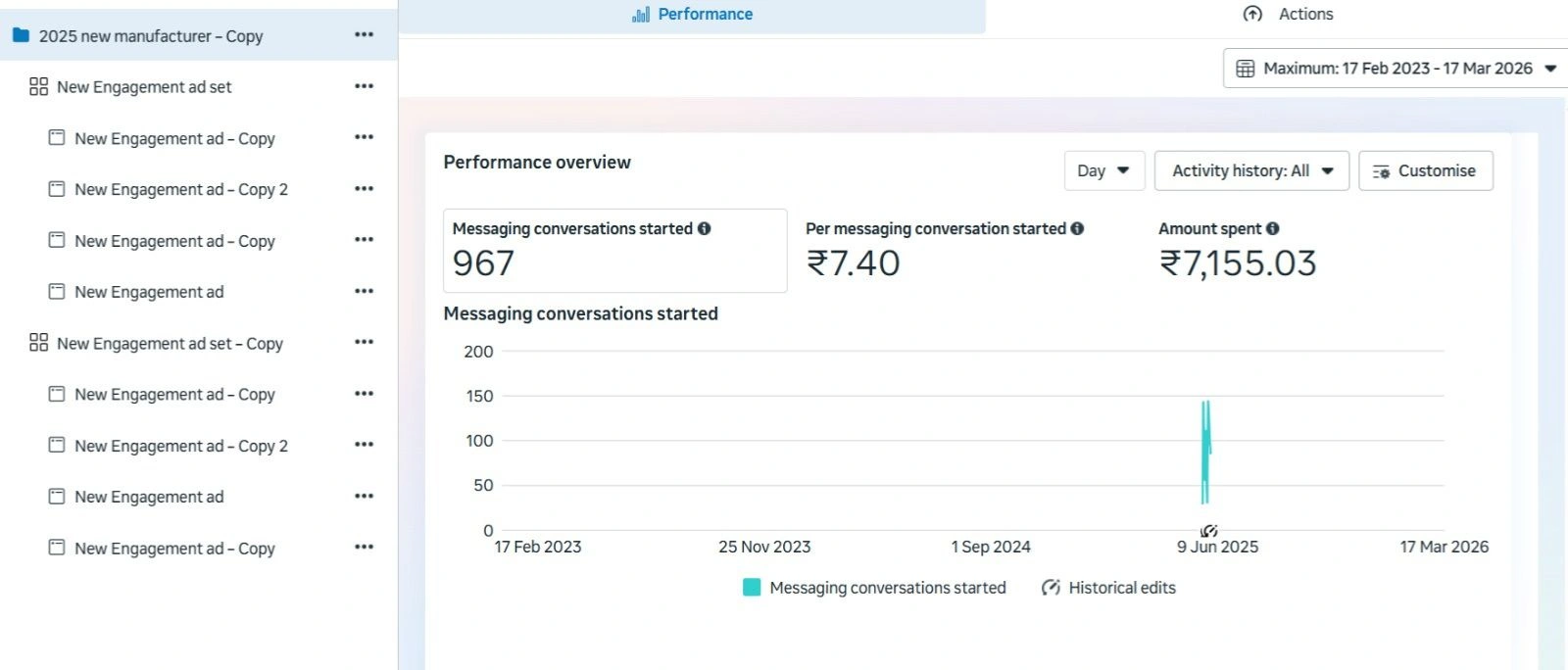
On the question of what performance looks like in practice: one Meta Ads campaign run for a manufacturing client generated 967 messaging conversations at ₹7.40 per conversation on ₹7,155 of spend. That's a messaging-conversation cost, not a qualified-lead cost, and the economics of a manufacturing enquiry won't transfer to real estate or BFSI — but it's a real number from a real account rather than a rounded-off claim.
Further reading and worked examples are on the BuzzSpire Media blog and in the published case studies. If you want a view on what your own numbers should look like, the free strategy session covers your current cost per lead, close rate, and where the money is leaking — before any package gets discussed.