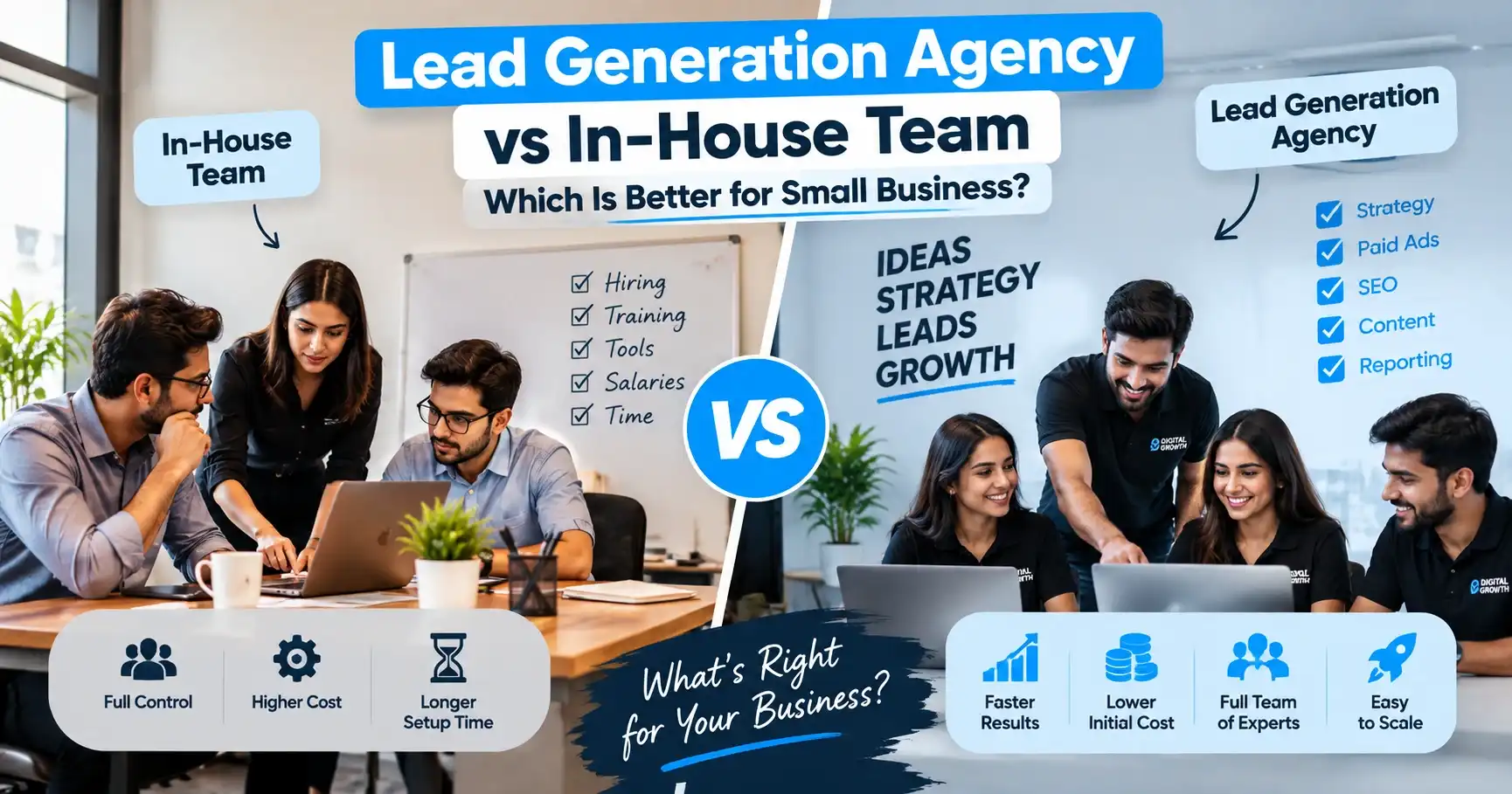
Lead Generation Agency vs In-House Team: Which Is Better for Small Business?
For most small businesses, a lead generation agency is the cheaper and faster option in year one, while an in-house team becomes more cost-effective only after you consistently need 200+ qualified leads a month and can afford to wait 4-6 months for the team to hit full productivity. The right choice depends less on your budget alone and more on how predictable your lead volume needs are and how much control you want over the process.
This isn't a one-size-fits-all answer, so let's break down exactly where each option wins and where it doesn't.
What "Lead Generation" Actually Costs You Either Way
Before comparing agency vs in-house, it helps to separate the real cost buckets:
People cost – salaries (in-house) or retainer/management fees (agency)
Tool cost – CRM, email software, ad platforms, data/enrichment tools
Ad spend – the money you put behind campaigns (this exists in both models)
Time-to-first-result – how long before leads actually start coming in
Management overhead – time you or a manager spends overseeing the work
Most small businesses only compare salary vs retainer and miss the other three, which is where the real cost difference usually shows up.
Cost Comparison: In-House Team vs Agency
Factor
In-House Team
Lead Gen Agency
Starting cost
High (hiring, tools, training)
Lower (retainer covers tools + team)
Time to see results
3-6 months (hiring + ramp-up)
4-8 weeks typically
Ongoing monthly cost
Fixed, regardless of output
Often tied to performance/scope
Flexibility to scale down
Hard (layoffs, notice periods)
Easy (pause or reduce scope)
Control over strategy
Full, day-to-day
Shared, agency drives execution
Access to specialized skills
Limited to who you hire
Broad (SEO, ads, copy, data — under one roof)
Risk if it doesn't work
You absorb hiring/training cost
You can switch agencies
A single in-house lead generation hire in most Indian metros — someone who can run paid ads, write copy, and manage a CRM — typically costs more in salary alone than a small agency retainer, before you even add software subscriptions or ad spend management time. That's the core reason small businesses lean toward agencies early on.
When an In-House Team Is Actually cheaper
In-house isn't always the expensive option. It usually becomes the smarter long-term bet when:
You need a consistent, high volume of leads every single month. Once your lead requirement is large and steady, a fixed salary starts costing less per lead than a scaling retainer.
Your product needs deep, ongoing explanation. If leads require someone who understands your product inside out (technical B2B, complex services), an in-house rep who lives inside your business daily builds that knowledge faster than an outside agency team rotating across clients.
You want leads tied directly into sales, not handed off. In-house teams sit closer to sales, so handoffs are faster and feedback loops are tighter.
You're already generating enough revenue to absorb the fixed cost even in slow months. Agencies flex with demand; salaries don't.
The catch: none of this pays off on day one. You're paying full-time cost while the team is still learning your market, your buyers, and your messaging.
When a Lead Gen Agency Makes More Sense
An agency is usually the better starting point for small businesses because:
You don't carry the hiring risk. No recruitment cost, no training period, no severance if it doesn't work out.
You get a full team, not one hire. A single in-house employee rarely covers strategy, ad management, copywriting, and reporting equally well. An agency brings specialists for each.
You can test the channel before committing. Most agencies work on shorter contracts (3-6 months) than the time it takes to fully train an in-house hire.
Tools are already included. CRM access, ad platform accounts, and reporting dashboards usually come bundled into the retainer instead of being separate line items you set up yourself.
You can pause or scale without HR complications. Reducing an agency's scope is a conversation. Reducing headcount is a process.
The trade-off: you have less day-to-day control, and the agency is managing your leads alongside other clients, not exclusively.
How Long Does It Take to Build an In-House Lead Gen Team?
Realistically, plan for 4-6 months before an in-house team performs at full capacity:
Hiring (4-8 weeks) – sourcing, interviewing, and closing the right candidate, especially for a skill set that spans ads, content, and CRM.
Onboarding and tool setup (2-3 weeks) – CRM configuration, ad account access, learning your product and ideal customer.
First campaigns and learning curve (4-6 weeks) – early campaigns are usually a testing phase, not a results phase.
Performance stabilization (2-3 months) – this is when you start seeing consistent, repeatable lead flow.
An agency, by comparison, is usually running live campaigns within 2-4 weeks of onboarding, because the team, tools, and processes already exist before you sign on. That head start is often the deciding factor for small businesses that can't afford a 6-month gap in lead flow.
A Practical Way to Decide
Instead of debating this in the abstract, run it against your own numbers:
If your lead requirement is under 100/month and you don't have a dedicated marketing manager → an agency almost always wins on cost and speed.
If you need 200+ leads/month consistently and already have someone to manage the team → in-house becomes worth the fixed cost over 12+ months.
If you're unsure how much lead volume you actually need → start with an agency for 3-6 months to establish a baseline before committing to a hire.
Many businesses eventually run a hybrid model — an in-house person who manages relationships and sales handoff, paired with an agency that runs the technical execution (ads, SEO, content). This gives you control without carrying the full skill-set cost in-house.
There's no universally "better" option here — only a better fit for your current lead volume, budget, and how soon you need results.