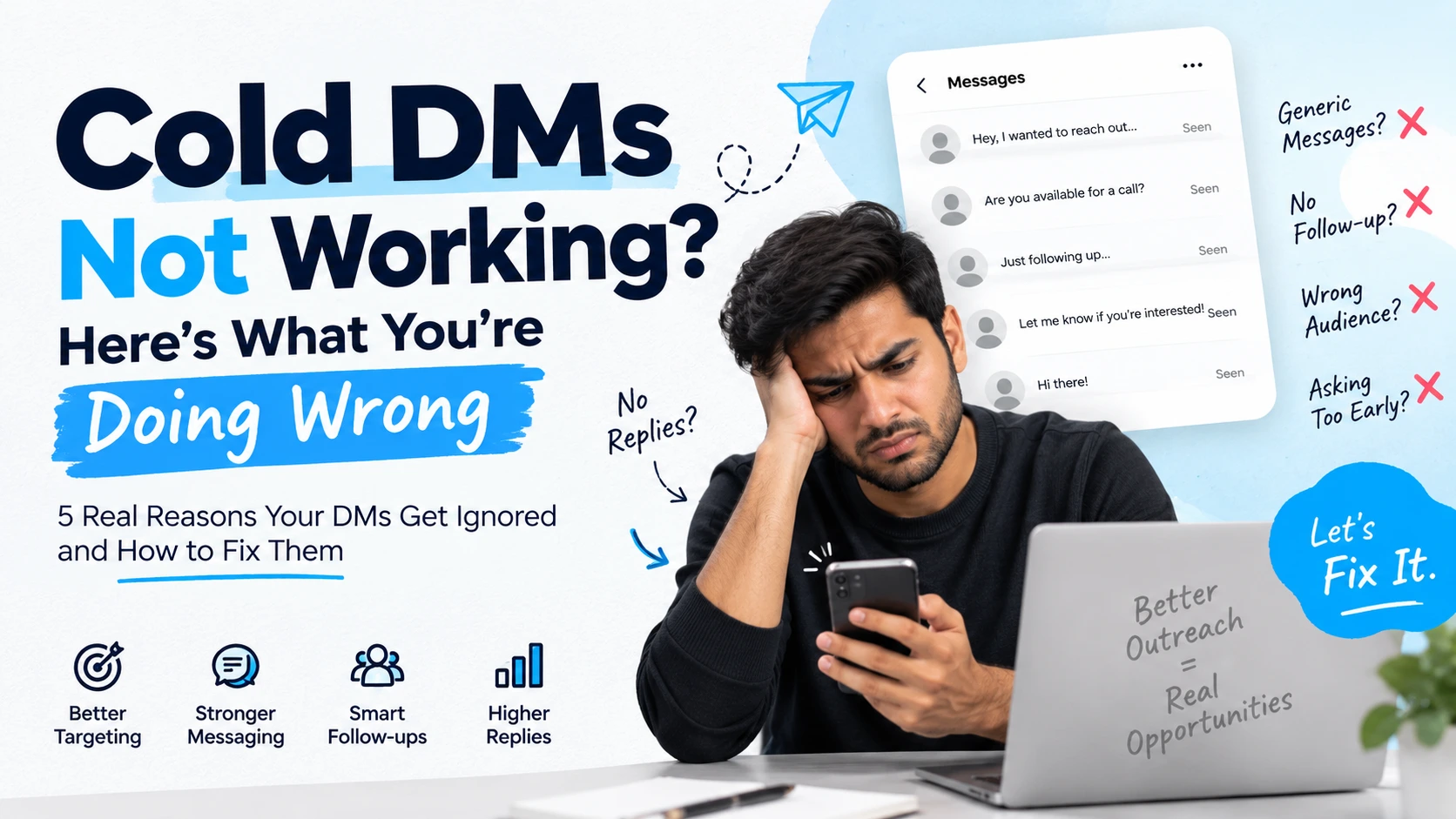
Cold DMs Not Working? Here's What You're Doing Wrong
If your cold DM outreach isn't working, the problem almost never comes down to bad luck or a saturated platform. It comes down to specific, fixable mistakes in how the message is written, who it's sent to, and when it's sent. Most people blame the algorithm or "cold outreach is dead" when the real issue is a message that reads like a template, sent to the wrong person, with no follow-up plan.
This isn't about sending more DMs. It's about sending fewer, better-targeted ones that actually get read.
Why Your Cold DMs Aren't Converting
There are five reasons cold DMs fail, and they show up in almost every outreach campaign that isn't converting.
The message is about you, not them. Most cold DMs open with "I help businesses like yours..." or "I wanted to reach out because I think we could work together..." The recipient hasn't asked what you do yet — they're deciding in the first two seconds whether this message is worth their time. If the opening line is about your service, your company, or your offer, it reads as a pitch, and pitches get ignored.
There's no proof of research. A generic DM and a researched DM look completely different to the person receiving them. "Hey, love your content!" signals mass outreach. A specific reference to something they posted, a problem visible on their profile or site, or a detail only someone who actually looked would know — that signals a real person took the time to look. People respond to attention, not volume.
The task comes too early. Many cold DMs ask for a call, a demo, or a purchase in the very first message. That's a big commitment from someone who doesn't know you yet. The DM's only job is to earn a reply — not to close a deal. If the first message is already asking for 30 minutes of someone's time, it's asking for too much too soon.
There's no follow-up. Most cold DM campaigns are one-and-done: send, wait, move to the next prospect. Response rates on a first message are naturally low because people are busy, not because they're uninterested. A short, low-pressure follow-up a few days later often gets more replies than the original message — but most people never send it.
The targeting is too broad. Sending the same message to a list of 500 loosely related accounts guarantees a low response rate, because most of those 500 people aren't actually a fit. A tighter list of 50 well-matched prospects, each with a slightly tailored opener, consistently outperforms a broad blast.
Why Do People Ignore Cold DMs?
People ignore cold DMs for the same reason they ignore cold calls and mass emails: the message doesn't signal that it was written for them specifically. When someone opens their DMs and sees a message that could have been sent to anyone, their brain files it as spam before reading past the first line — even if the platform's algorithm doesn't flag it as spam.
There's also a trust gap. A DM from a stranger carries none of the credibility that a referral, a mutual connection, or an existing relationship carries. That gap has to be closed somehow — usually through specificity (proving you looked at their profile or business) or through social proof (a shared connection, a recognizable client, a result they can verify).
Timing plays a role too. A DM sent at 3 AM their time, or right after they've just posted something unrelated, is easy to miss or dismiss. Messages sent when the recipient is more likely to be actively checking the platform — shortly after they've posted, commented, or engaged with something — tend to get seen faster.
Fixing the Message Itself
The structure of a cold DM that gets replies looks different from the structure of a pitch.
Open with them, not you. Reference something specific — a recent post, a product they launched, a gap you noticed. This should take one sentence, not three.
State the reason you're reaching out in plain language. No jargon, no "synergy," no "circle back." Say what you noticed and why it made you want to message them.
Make the task small. Instead of "Can we hop on a call?", try "Would it be useful if I sent over a quick example?" or "Worth a two-line reply if this is relevant?" Small asks get answered. Big asks get ignored.
Keep it short. A cold DM that runs six paragraphs won't get read past the second one. Three to five short lines is usually enough to earn a reply.
Sounds like a person, not a script. Contractions, plain words, and a normal tone read as human. Overly polished, formal language reads as automated — even when a human wrote it.
How to Improve Cold DM Response Rate
A few structural changes tend to move response rates more than tweaking word choice:
Narrow the list before sending anything. A smaller, better-matched list beats a large generic one every time.
Personalize the first line only, template the rest. Full personalization for hundreds of DMs isn't realistic, but the opening line is what decides whether the rest gets read — so that's where the effort should go.
Send a follow-up. One follow-up, three to five days later, referencing the original message briefly. Don't repeat the full pitch — just a short nudge.
Test the task, not just the opener. If replies are low even with a strong opener, the task itself might be too big. Lower the commitment being requested.
Track replies by segment, not just overall. A campaign that looks like it's underperforming might actually be doing fine with one audience and badly with another — averaging them together hides that.
→ Get a Free Lead Generation Consultation
What's a Good DM Response Rate?
Response rates vary a lot by platform, industry, and how targeted the list is, so there's no single benchmark that applies everywhere. As a general reference point, cold outreach that's well-targeted and personalized often lands somewhere in the 10-20% reply range, while broad, generic outreach frequently sits in the low single digits. These are reference ranges, not guarantees — the only number that actually matters is your own baseline, tracked over time, so you can tell whether changes to your message or targeting are actually helping.
→ Explore Our Meta Ads Services
How Many DMs Should I Send Per Day?
This depends more on platform limits and message quality than on any fixed "ideal number." Sending too many DMs too quickly on platforms like Instagram or LinkedIn can trigger spam restrictions or account limits, regardless of how good the messages are. It's generally more effective to send a smaller, well-targeted batch each day — personalizing the opening line for each one — than to max out a daily limit with a copy-pasted message. Quality of targeting and personalization has a bigger impact on results than raw volume.
The Real Fix
Cold DM outreach that isn't converting is rarely a platform problem. It's a message problem, a targeting problem, or a follow-up problem — usually some combination of the three. Fixing it doesn't require sending more messages. It requires sending fewer messages to better-matched people, opening with something specific to them, asking for less in the first message, and following up when the first one doesn't land.
The DMs that get replies aren't the cleverest ones. They're the ones that read like they were actually written for the person receiving them.